

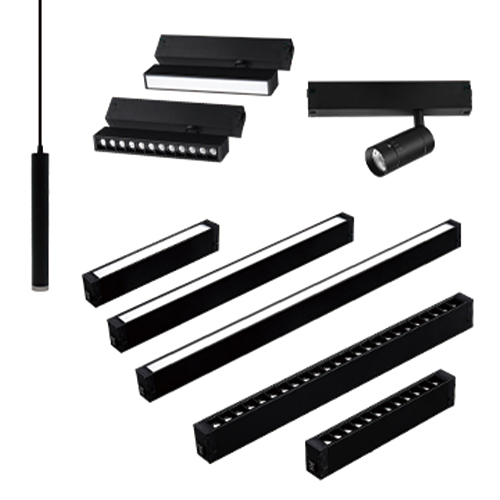
Recessed, Surface-Mounted or Suspended Magnetic Track Lighting?
Magnetic track lighting installation types shape the ceiling detail, wiring route, maintenance access, and final visual effect of a lighting project. Recessed rails sit within a prepared ceiling slot. Surface-mounted rails attach directly to the ceiling. Suspended rails hang below the ceiling on wires or rods.
The best option depends on the ceiling structure, project stage, lighting height, and access requirements. A clean visual effect alone is not enough to select a system. The rail, power feed, driver, light modules, controls, and mounting accessories must work together as one installation.
What Are the Three Magnetic Track Lighting Installation Types?
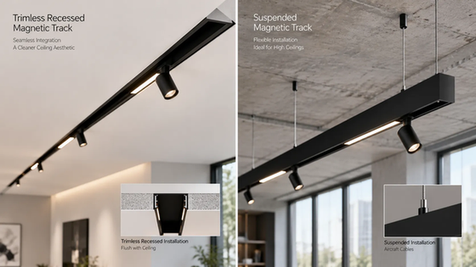
Recessed magnetic track lighting is integrated into the ceiling. Installers create a channel or use a prepared recess, position the rail, connect the power feed, and finish the surrounding ceiling surface. This method suits new construction and renovation work where the ceiling design is still open.
Surface-mounted magnetic track lighting is fixed to the visible ceiling surface. The installer checks the fixing points, routes the wiring, aligns the rail, and secures the system with suitable hardware. It works well for concrete ceilings, finished ceilings, and projects that need a shorter installation path.
Suspended magnetic track lighting is held below the ceiling by suspension wires, rods, or a specified hanging kit. The rail becomes a lower lighting plane. This approach suits high ceilings, open ceilings, retail interiors, offices, and layouts where the fixtures need to sit closer to the working area.
Each type can use different rails and accessories. Confirm the complete configuration before ordering.
How Does Recessed Magnetic Track Lighting Work?
Recessed installation gives the ceiling a continuous, built-in appearance. The rail is placed inside a slot or recessed profile, so the visible part of the system remains close to the finished ceiling plane. This makes the method useful for projects that place a high value on a quiet ceiling line.
The ceiling must provide enough depth and width for the rail and its accessories. Before cutting, confirm the rail dimensions, ceiling structure, wiring route, driver position, and access for future inspection. A drawing should show rail joints, power feeds, corners, end caps, and fixture positions.
Recessed installation suits new ceilings, integrated retail or hospitality interiors, and linear layouts that follow furniture or display walls.
Coordinate the lighting designer, electrical contractor, ceiling installer, and supplier before work begins. The ceiling cavity and opening detail must match the selected rail.
For projects with limited ceiling depth, review the ultra-thin magnetic track light system and confirm the dimensions of the selected rail and fixtures.
When Is Surface-Mounted Magnetic Track Lighting the Better Choice?
Surface-mounted installation places the rail directly against the ceiling. It reduces ceiling cutting and gives installers a clear route for alignment and fastening. The method is useful when the ceiling is already finished or when the structure does not provide a suitable cavity for a recessed rail.
The main planning task is the fixing detail. Check the ceiling material, anchor type, fixing spacing, rail straightness, and cable entry. Concrete, plasterboard, metal framing, and timber ceilings may require different hardware.
Surface-mounted systems suit renovation projects, finished concrete ceilings, offices, shops, galleries, and homes that need accessible inspection.
The visible rail becomes part of the interior design. Select the finish, rail width, and layout with the ceiling color and room geometry in mind. Check straight alignment along every run.
Sampo lists high-voltage and low-voltage magnetic track product families, including 220V and 48V categories. Review the 220V magnetic track light system for the selected rail, power-feed, and fixture combination. Record the building supply voltage and the track or driver voltage as separate entries in the project schedule.
Where Does Suspended Magnetic Track Lighting Fit Best?
Suspended installation lowers the rail from the structural ceiling. Suspension wires or rods transfer the rail load to approved fixing points, while a power cable feeds the system through the ceiling or suspension assembly. The installed height determines the relationship between the light source, work surface, and occupants.
Suspended magnetic track lighting is useful for high or open ceilings, offices, meeting rooms, retail displays, and spaces where the lighting line must sit below ducts or beams.
Plan suspension spacing, rail joints, total rail weight, cable routing, and the position of every power feed. The rail should remain level after the fixtures are installed. In areas with air movement, check whether the suspension arrangement allows unwanted movement.
The hanging height affects glare, beam coverage, cleaning access, and nearby equipment. Show the finished rail elevation on the lighting plan.
For low-voltage projects, the 48V magnetic track light system category can be reviewed alongside the driver and fixture schedule. The final configuration still needs confirmation for the chosen rail and control method.
Recessed vs Surface-Mounted vs Suspended Magnetic Track Lighting
|
Project factor |
Recessed |
Surface-mounted |
Suspended |
|
Ceiling preparation |
Requires a planned slot or recess |
Requires direct fixing points |
Requires structural suspension points |
|
Finished appearance |
Integrated with the ceiling |
Visible rail line |
Rail hangs below the ceiling |
|
Renovation suitability |
Depends on ceiling depth and finishing work |
Suitable for many finished ceilings |
Suitable where the structure accepts hanging hardware |
|
Maintenance access |
Depends on the ceiling design |
Usually direct and visible |
Usually accessible from below |
|
Height adjustment |
Fixed close to the ceiling |
Fixed to the ceiling |
Set by suspension length |
|
Main planning issue |
Cut-out accuracy and cavity depth |
Anchors, alignment, and cable entry |
Support, level, height, and power routing |
|
Common applications |
New interiors and integrated ceilings |
Retrofits, concrete ceilings, and visible layouts |
High ceilings, offices, shops, and open interiors |
Use the table to narrow the installation method, then check electrical requirements, voltage, fixture mix, and maintenance access.
How Should You Choose the Right Installation Type?
Start with the ceiling. A new ceiling with sufficient depth can accommodate a recessed rail. A finished concrete ceiling often supports surface mounting. A high or open ceiling may suit a suspended lighting plane.
Then define the lighting task. A retail display may need adjustable spotlights along a suspended or surface-mounted rail. A residential corridor may need a compact recessed line. An office meeting table may benefit from a suspended rail that places the fixtures at a controlled height.
Check service access next. Drivers, power feeds, connectors, and control devices need planned locations and future access.
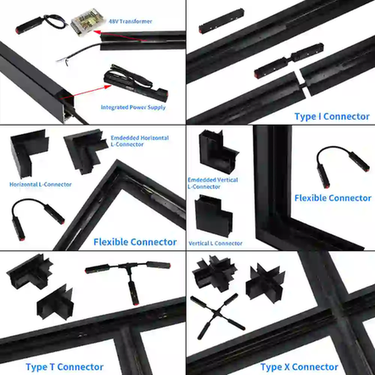
Finally, check compatibility. Record the input voltage, track voltage, driver specification, dimming method, fixture wattage, rail length, connector type, and accessory list. A connector that fits physically does not confirm electrical compatibility. The supplier should review the complete bill of materials and the drawing before production.
What Should Be Confirmed Before Ordering?
Send the following information with the quotation request:
- Ceiling type, structure, and finished height
- Preferred installation type and mounting detail
- Rail layout, lengths, corners, joints, and power-feed points
- Recessed cut-out dimensions or surface-fixing requirements
- Suspension height, fixing locations, and hanging hardware when applicable
- Building input voltage and selected track or driver voltage
- Fixture types, quantities, wattage, beam angle, CCT, and CRI
- Dimming, sensor, or smart-control requirements
- End caps, connectors, power heads, recessed parts, and spare components
- Destination market, compliance requirements, packaging, quantity, and delivery date
Sampo Lighting’s published product range covers 220V, 48V, semi-flexible, ultra-narrow, and ultra-thin magnetic track families, along with different rail and fixture formats. When a project includes several ceiling conditions, provide the drawings and fixture schedule so the selected components can be checked together. This keeps the supplier discussion connected to the installation decision and helps produce a clearer project BOM.
Projects that need a curved or adaptable route can also review the semi-flexible magnetic track light system and confirm its mounting limits before finalizing the ceiling detail.
Common Installation Mistakes to Avoid
Check the cavity depth, fixing structure, or suspension points before choosing the rail.
Mixing voltage systems creates another risk. Keep the building supply, driver output, track rating, and fixture rating as separate entries in the schedule.
Count power feeds, connectors, end caps, suspension parts, recessed components, and spares with the rail and luminaires.
A long rail also needs a layout review. Mark every joint and feed point, check the finished alignment, and confirm how installers will reach the driver and wiring.
Finish with circuit, fixture, and dimming tests. Record the rail type, driver location, control method, and replacement fixture information.
FAQ
Q1: Which magnetic track lighting installation type suits a renovation project?
Surface-mounted installation often fits renovation work because the rail can be fixed to an existing ceiling. The ceiling material, anchor type, wiring route, and final rail appearance still need to be checked.
Q2: Does recessed magnetic track lighting require a deeper ceiling?
Recessed installation requires enough space for the selected rail, accessories, wiring, and finishing detail. Confirm the product dimensions and cut-out requirements before work begins.
Q3: Can magnetic track lighting be suspended from a high ceiling?
Yes, when the ceiling structure supports the suspension hardware and the rail, power cable, height, and spacing are planned together. The finished rail should remain level under the fixture load.
Q4: Can 220V and 48V magnetic track systems use the same installation type?
Both product families may be offered in different mounting formats. The rail, driver, power feed, fixture, and control system must be confirmed as one compatible configuration.
Q5: What should be sent to a supplier for a magnetic track lighting quotation?
Send the ceiling details, preferred installation type, rail layout, fixture schedule, voltage, controls, accessories, quantities, destination market, and delivery requirements. A drawing and BOM help the supplier review the complete system.


