

How to Choose a Magnetic Track Lighting Manufacturer in China
Picking an LED track light supplier in China changes product quality and project timing. It also affects the service your buyers get later. A picture book might look nice. But, a real buyer needs proof of factory skills, testing rules, and order support.
This guide shows how to check a Chinese magnetic track lighting manufacturer. We will look at what to know before you call them. We will also check factory steps, the sample process, and order terms.
What Should You Define Before Contacting an LED Track Light Supplier?
Write a short plan first. Clear rules help each factory give the exact same price. It also helps them pick the right parts for you.
Define the Application and Lighting Task
Tell them where the lights will go. Tell them what each room needs. Shops might want spotlights. Hotels need dimming setups. Offices mix normal light with bright desk spots. Art rooms need very exact light beams. Also, share the ceiling height, heat, and any water or dust risks. This helps pick the right housing and IP rating.
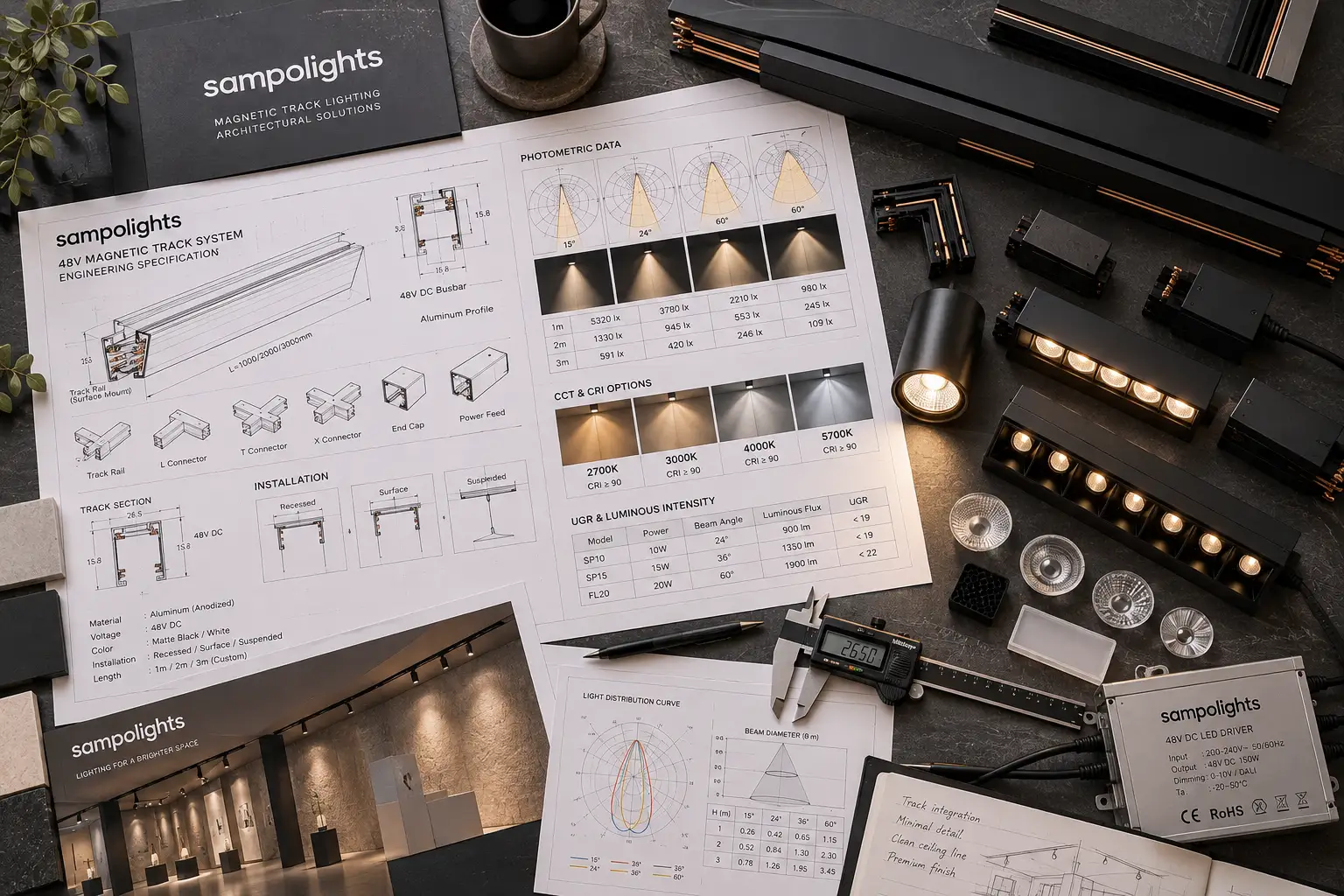
Prepare a Technical Specification
Make a list of these needed details:
- Wattage and lumen output
- Color temperature and CRI
- Beam angle and input voltage
- Dimming or control method
- Track standard or magnetic interface
- Surface, recessed, or suspended mounting
- Target-market certifications
For a magnetic system, tell them the rail shape, driver spot, and rail length. The track and light must match. You can compare available system families through Sampo Lighting’s LED track light product range before sending a specification.
Set the Commercial Requirements
Tell the factory if you want normal items or your own brand boxes. Ask about OEM or ODM work. Share your total yearly order size. Ask about their MOQ, delivery date, and warranty.
How Can You Verify a Supplier’s Factory Capability?
Factory skills show if they can make your approved sample again. Check their papers or take a video tour to be sure.
Check the Legal and Physical Identity
Ask for their real company name, factory address, and business license. Make sure these match the names on their bills and labels. Ask for a live factory video. Look at the work lines, testing spots, and packing rooms. Sometimes the sales office is not the actual factory.
Ask Who Performs Key Processes
Ask who makes the housing, LED parts, and driver. Ask who does the final check and packing. The factory should tell you what they do inside. They must also tell you if they hire outside help.
Review Engineering and Support Resources
Ask if they have engineers to check plans and match drivers. This help matters a lot when you need OEM changes.
Which Product and Engineering Capabilities Matter?
A good factory matches their items to your plan. Look closely at what they offer.
Evaluate the LED Track Light Range
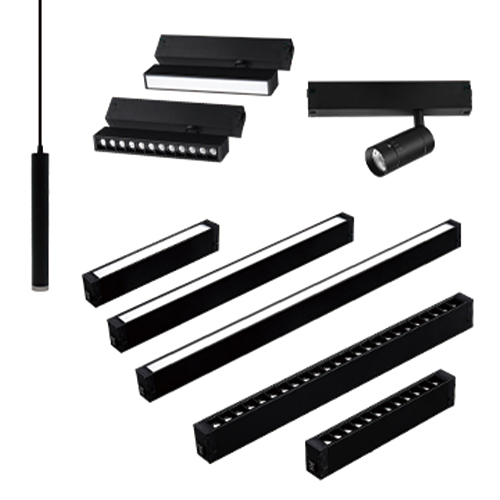
See if they make what you need. They might have standard LED track lights, magnetic track light systems, surface-mounted rails, or recessed rails. They should also have suspended systems, adjustable spotlights, linear modules, grille lights, and flood lights. Sampo Lighting offers 220V magnetic track light systems, as well as semi-flexible, ultra-narrow, and ultra-thin magnetic track systems. A big range makes planning easy.
Check Optical and Electrical Data
Ask for facts about lumen output, wattage, CRI, CCT, and beam angle. Ask for IES or LDT files for your computer designs. For magnetic systems, ask for rail drawings and driver notes. For low-voltage projects, review the 48V magnetic track light systems and confirm the driver, rail, and fixture ratings together. A voltage sticker does not prove it works well.
Confirm Customization Boundaries
Ask what you can change easily. You might want to change the housing color, rail length, wattage, CCT, CRI, or dimming method. If the layout follows a curve, review the semi-flexible magnetic track light system and ask the supplier to confirm its shaping limits. For big changes, ask about sample times and total costs.
How Should You Check Quality and Certification Documents?
Good test papers help you buy safely. Get them early.
Request a Complete Document Set
Ask for product data sheets, dimensioned drawings, wiring diagrams, and driver specifications. You also need installation instructions, photometric files, safety test reports, and warranty terms. Check the date on each paper.
Verify Certification Scope
Check if the paper covers your exact lamp, rail, and driver. Look at the allowed voltage and country market. One paper does not cover a whole catalog.
Review Quality-Control Records
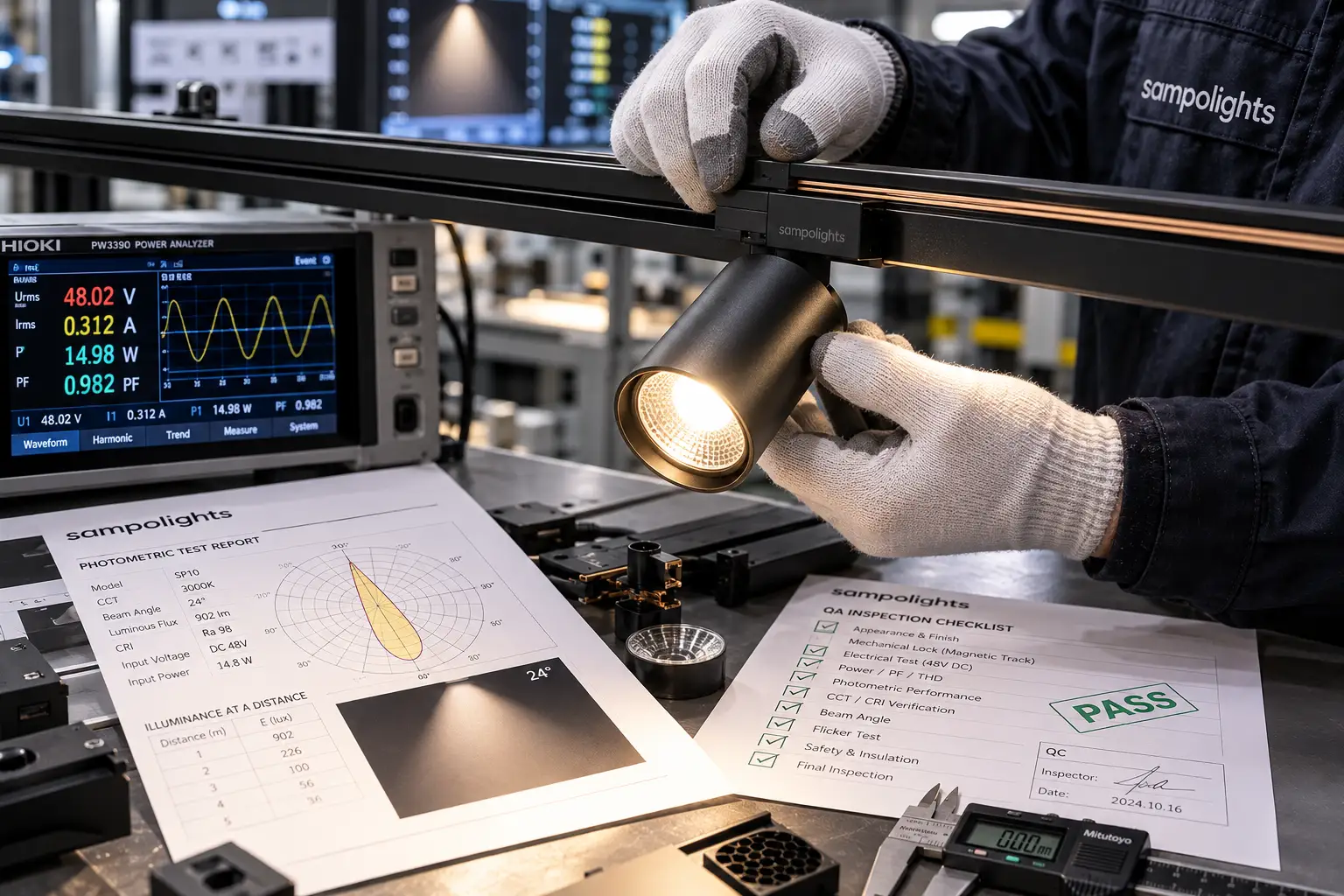
Ask how they check incoming parts and finished boxes. Good records track test tools and bad items. Ask how they control changes on repeat orders.
Why Are Samples and Factory Audits Important?
Samples prove they can build your exact design.
Test the Sample in the Intended Application
Look at the real brightness and color. Check the CCT, CRI, and beam shape. Listen for driver noise. Feel the heat. Test the dimming response and smart-control communication. Try the fixture-to-rail fit. Use your real ceiling or wall finish to test it.
Run a Small Pilot Installation
A small test helps you check rail joints and fixing points. Write down the approved model numbers and test results.
Set a Production Approval Gate
Decide who says “yes” to the sample before big production starts. Write down your okay for the rail, driver, finish, and cartons.
How Should You Compare MOQ, Lead Time, and OEM Terms?
Business terms show if the factory fits your growth.
MOQ and Pricing Structure
Check the MOQ for normal items and special color changes. Ask about price drops on big orders. See if drivers and packaging are included.
Lead Time and Capacity
Ask for timelines for samples, production, and shipping. Ask how they handle busy seasons. A good factory tells you about delays early.
OEM and ODM Responsibilities
Agree on who owns the design and molds. Keep secrets safe. Put the final rules in your buy contract.
What After-Sales Support Should an LED Track Light Supplier Provide?
Good service must last a long time.
Warranty and Replacement Policy
Ask what the warranty covers. Find out who pays for shipping if things break. Check the rules for broken drivers, LED modules, and rails.
Spare Parts and Repeat Orders
Ask how long they will sell the exact same parts. Check if future orders will use the same size and optics.
Technical Response and Documentation
Find out who to call for help. A clear help path fixes issues fast.
Why Consider Sampo Lighting for Commercial Track Light Projects?
Foshan Sampo Lighting & Electric Co., Ltd. started in 2014. They offer OEM, ODM, sales, and service for LED track lights and lighting tracks. They have an area of about 29,800 square meters. They employ more than 200 people. They sell 220V, 48V, semi-flexible, ultra-narrow, and ultra-thin magnetic track systems. Buyers can use the Sampo contact page to share drawings, fixture schedules, control needs, quantities, and delivery requirements.
FAQ
Q1: How Do I Verify an LED Track Light Supplier in China?
A: Check their real company name and factory address. Look at their testing rules and sample results. Take a video tour if you can.
Q2: What Documents Should an LED Track Light Manufacturer Provide?
A: Ask for data sheets, wiring diagrams, driver specifications, and test reports. Make sure they match your model exactly.
Q3: Should I Request Samples Before Placing a Bulk Order?
A: Yes. Test the light output, CCT, CRI, and driver behavior. Check the fit before they make a lot.
Q4: What Is the Difference Between an LED Track Light Manufacturer and a Trading Company?
A: A factory controls the actual making part. A trading company buys from many places. Both can work if they offer good help and papers.
Q5: How Can I Compare OEM and ODM Lighting Suppliers?
A: Look at their sample times, MOQ, and support for repeat orders. Pick the one that fits your yearly needs.


