

Do You Need a Transformer for a 220V Magnetic Track Light System?
When designing commercial showrooms, modern office spaces, or high-end residential interiors, lighting specifiers frequently face a technical fork in the road regarding track lighting architecture. Magnetic track systems have redefined architectural lighting due to their flexible, click-and-go fixture placement, yet the underlying voltage configuration remains a source of confusion for many procurement managers. The most common question emerging during the technical assessment stage is whether a 220v magnetic track light system requires an external transformer. The short answer is no; high-voltage magnetic tracks connect directly to the standard grid. Unlike low-voltage setups that demand a bulky, separate power supply hidden inside a drywall ceiling cavity or maintenance hatch, a direct mains voltage track lighting approach introduces distinct structural and budgetary advantages that resonate with B2B buyers who manage large-scale real estate portfolios.
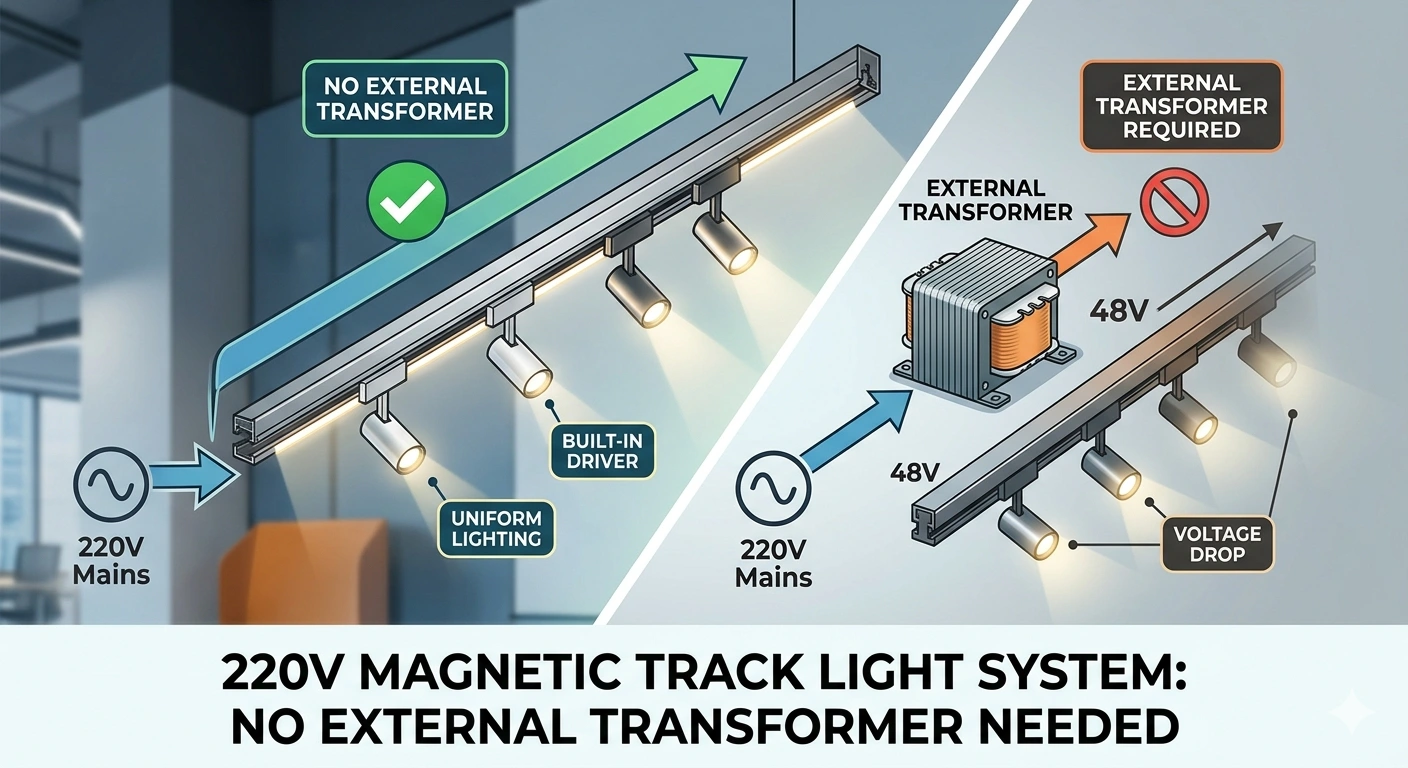
Understanding this distinction is critical for electrical contractors looking to streamline site installations. Eliminating external hardware drastically simplifies the initial layout phase and alters the long-term maintenance blueprint of a commercial venue. While low-voltage alternatives remain prevalent, switching to a high voltage track light setup eliminates hidden failure points. For those evaluating technical specifications, deciding between a driverless magnetic light vs 48v magnetic track often comes down to installation flexibility, total load capacity, and long-term labor costs.
How Does 220V Magnetic Track Lighting Work Without a Transformer?
To understand how high-voltage systems bypass centralized power supplies, one must examine the internal engineering of the lighting fixtures. In a traditional 48V low-voltage setup, a large, centralized transformer steps down the incoming AC mains voltage to DC power before it ever reaches the track rail. With a high-voltage system, the track rail itself carries the standard AC 220V input directly through its copper conductors. The power conversion happens inside the individual track heads rather than in a distant, overheating ceiling enclosure.
Each high-voltage magnetic light fixture features a micro-engineered, built-in LED driver concealed neatly within the adapter base that snaps into the rail. This integrated EMC driver handles the rectification and voltage regulation locally for that specific fixture. Engineers at advanced manufacturing facilities, such as Foshan Sampo Lighting & Electric Co., Ltd., focus heavily on scaling down these individual power drivers so they fit within minimalist aesthetic profiles without sacrificing thermal dissipation.
By feeding raw AC 220V power directly into the track rail, the system treats the entire length of the track as an extension of the building’s electrical wiring. When a spotlight or linear floodlight is clicked into position, its robust mechanical contacts tap into the continuous line voltage. The self-contained driver steps down the power to the exact milliamps needed by the onboard LED chips, making external power housing completely redundant.

220V vs. 48V Magnetic Track Lighting: 4 Key Differences for B2B Buyers
For procurement professionals weighing structural choices for an upcoming project, evaluating system limits prevents expensive mid-construction revisions. Below is a detailed engineering comparison detailing how mains voltage systems stack up against low-voltage alternatives across major commercial operational metrics.
|
Performance Metric |
48V Low-Voltage Magnetic Systems |
220V High-Voltage Magnetic Systems |
|
Transformer Requirement |
Mandatory external centralized power supply |
None; utilizes direct AC mains voltage connection |
|
Max Continuous Run Distance |
15 meters maximum before suffering light degradation |
Up to 100 meters on a single power feed without loss |
|
Voltage Drop Vulnerability |
High; requires meticulous calculations and split feeds |
Virtually zero over standard commercial interior runs |
|
Installation Labor & Access |
High; requires dedicated drywall access panels |
Low; standard wiring protocols with zero hidden hardware |
Why B2B Sourcing Managers Prefer 220V Magnetic Lighting Systems
In large-scale commercial lighting projects like hotel lobbies, expansive furniture galleries, or car dealerships, run length dictates the electrical design. Low-voltage track setups are notoriously prone to voltage drop, a phenomenon where the resistance of the track conductors causes the voltage to decrease over long distances, resulting in noticeably dimmer fixtures at the far end of the line. Correcting this in a 48V system requires installing multiple power feeds every 10 to 15 meters or thick, expensive supply cables. A 220V high-voltage track rail completely eliminates this headache, allowing continuous runs of up to 100 meters on a single power entry while maintaining uniform lumen output from the first fixture to the last.
From an investment standpoint, procurement managers look past the initial price tag of the fixtures to evaluate total installed cost and lifecycle maintenance. Centralized transformers are traditionally the weakest link in an LED ecosystem; they generate localized heat, degrade over time, and eventually fail. When a hidden 48V transformer fails behind a finished ceiling, maintenance crews must spend hours locating the access panel, interrupting business operations.
With a driverless track layout where the regulation is decentralized, if an individual fixture’s internal driver fails after years of heavy use, only that single light goes out. A floor manager can snap out the bad fixture and click in a replacement within five seconds without turning off the rest of the system or hiring an external electrical contractor. This makes the system virtually maintenance-free from an infrastructure standpoint.
Safety Standards: What to Look For in High-Voltage Magnetic Lighting?
Operating a magnetic track at line voltage demands impeccable engineering to guarantee safety during fixture adjustments. Because users can physically insert and remove fixtures while the track might be live, top-tier manufacturers implement multi-layered insulation protocols. When evaluating suppliers, sourcing teams should look for structural safety elements like deep-recessed copper busbars wrapped in co-extruded PVC insulation profiles. This prevents accidental finger contact with the live conductors during installation or repositioning.
While low-voltage systems operate at reduced voltage, high-voltage systems can achieve an equally high level of safety through refined manufacturing processes. Electrical noise can play havoc with building automation and wireless networks. High-quality systems depend on an EMC certified LED driver within every lamp to suppress electromagnetic interference and prevent visible camera flicker, which is a dealbreaker for modern retail environments and digital studios. A reputable Foshan track light manufacturer ensures that their high-voltage product families pass strict global compliance tests, incorporating safety mechanical locks that physically latch the fixture to the rail alongside the magnetic force. This dual-action mechanism ensures that even during unexpected building vibrations, the high-voltage connection remains perfectly stable and secure.
Conclusion
Opting for a high-voltage architectural track setup is a strategic decision that fundamentally alters installation speed, system longevity, and overall project costs. By housing individual power regulators within each fixture rather than relying on a centralized external transformer, these systems eliminate common low-voltage pain points like severe voltage drop, limited run distances, and tedious ceiling maintenance access requirements. For large commercial layouts where reliability and clean aesthetics are paramount, skipping the transformer provides a streamlined, robust solution that stands up to demanding operational schedules.
People Also Ask
Q1: Can I use 48V fixtures on a 220V magnetic track?
A: No, low-voltage 48V fixtures cannot be used on a high-voltage 220V track rail. Attempting to snap a 48V fixture into a line-voltage track will instantly bypass the voltage limitations of the lower-rated components, causing catastrophic failure, burning out the LED chip, and posing a severe fire hazard. Tracks and fixtures must share identical voltage ratings.
Q2: Is 220V magnetic track light safe for residential use?
A: Yes, high-voltage magnetic tracks are perfectly safe for residential environments provided they carry proper international safety certifications. High-end systems utilize a deeply recessed rail profile where the live copper conductors are completely shielded by thick PVC insulation, making it impossible for standard tools or human fingers to make contact with the current.
Q3: How many lights can I run on a single 220V track loop?
A: The total number of fixtures depends entirely on the amperage rating of your circuit breaker and the wattage of individual lamps. Because a standard 10-amp commercial lighting circuit at 220V can handle up to 2200 watts, you could theoretically run over one hundred 15-watt LED spotlights on a single power feed, far surpassing the strict power limitations of low-voltage transformers.
Q4: Where can I wholesale reliable 220V magnetic track lighting?
A: When sourcing at a commercial volume, it is best to partner with an established OEM factory that controls the entire production process from aluminum extrusion to driver engineering. Working directly with a specialized manufacturer in lighting hubs like Guangdong ensures you get certified systems that match local building codes while keeping project costs well within budget.


