

48V vs 220V Magnetic Track Light System: Which Is Better for Commercial Projects?
Choosing between a 48V vs 220V magnetic track light system affects more than voltage. For commercial projects, it influences installation safety, fixture flexibility, maintenance cost, dimming control, and long-term supply stability. A retail store may need adjustable spotlights for changing displays, while a hotel corridor may need a clean ceiling finish and stable lighting performance. For importers, distributors, contractors, and lighting brands, the better choice depends on project conditions, local electrical requirements, and system compatibility.
Both 48V magnetic track lighting and 220V magnetic track lighting can be used in commercial spaces. The key is to understand where each system performs better before placing a bulk order.
What Is a 48V Magnetic Track Light System?
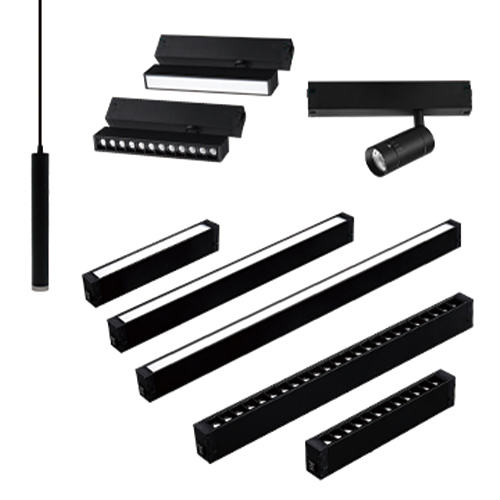
A 48V magnetic track light system is a low voltage magnetic track lighting solution. It usually includes magnetic track rails, power supplies, connectors, spotlights, grille lights, flood lights, pendant lights, and linear modules. Because the system is low voltage, it is widely used in spaces that require flexible lighting layouts and safer fixture adjustment.
Common applications include retail stores, showrooms, offices, galleries, museums, villas, boutique stores, and modern commercial interiors. These spaces often need lighting modules to be moved, replaced, or combined as layouts change.
Sampo Lighting’s 48V Magnetic Track Light System includes track rails, recessed track options, surface mounted track options, low-wattage magnetic spotlights, COB pendant lights, linear magnetic grille lights, and magnetic flood lights. This product range supports layered lighting for commercial and residential projects.
The main advantage of 48V magnetic track lighting is flexibility. A single 48V magnetic track rail can support different fixture types, including magnetic spotlights, grille lights, flood lights, pendant lights, and linear modules. This makes it suitable for stores, galleries, showrooms, and offices where lighting layouts may change over time.
What Is a 220V Magnetic Track Light System?
A 220V magnetic track light system works with high-voltage power conditions. It is often considered for projects with fixed electrical plans or spaces where direct high-voltage track lighting is preferred.
Compared with 48V systems, 220V magnetic track lighting requires closer attention to wiring, insulation, installation quality, safety standards, and certification. It can be suitable for commercial and residential projects when the electrical conditions are clearly defined.
A 220V magnetic track light system may fit projects with stable layouts and fixed wiring. Before choosing a 220V magnetic track light supplier, buyers should check track structure, driver configuration, insulation design, installation instructions, and local compliance requirements.
48V vs 220V Magnetic Track Light System: Main Differences
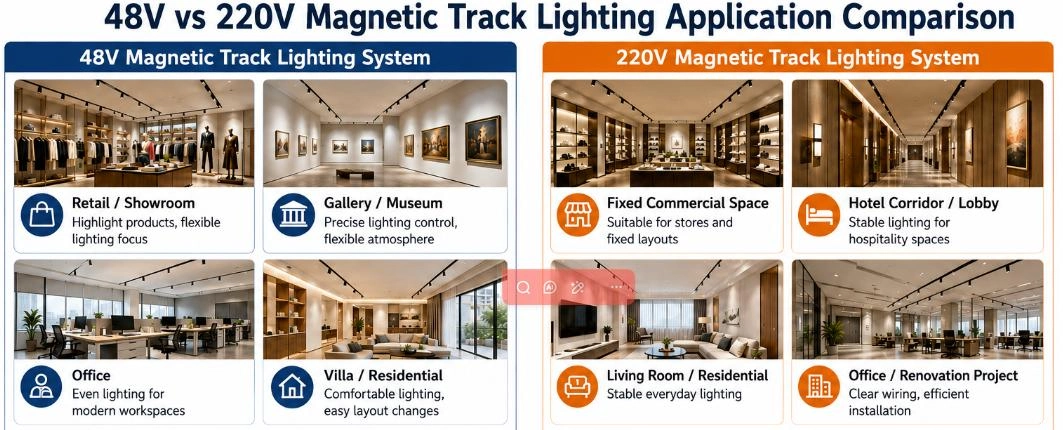
The difference between 48V and 220V magnetic track lighting should be viewed through project use, not only product specification. Many commercial buyers compare voltage first, but the real decision often comes down to safety requirements, installation method, fixture flexibility, long-term maintenance, and total project cost.
|
Factor |
48V Magnetic Track Light System |
220V Magnetic Track Light System |
|
Voltage Type |
Low voltage |
High voltage |
|
Safety Focus |
Suitable for flexible low-voltage layouts |
Requires stricter electrical installation |
|
Fixture Flexibility |
Easier to move, replace, and combine modules |
More dependent on fixed wiring and system design |
|
Common Applications |
Retail stores, galleries, museums, offices, showrooms, villas |
Commercial and residential projects with fixed electrical plans |
|
Installation Check |
Power supply, driver, rail compatibility, module matching |
Wiring, insulation, certification, local electrical standards |
|
Buyer Concern |
System compatibility and module supply |
Safety compliance and installation control |
Voltage and Electrical Safety
48V magnetic track lighting is generally more suitable for low-voltage commercial lighting layouts. It is commonly selected where lighting modules need to be adjusted or replaced without changing the whole system. This is one reason 48V systems are popular in retail, exhibition, and office projects.
220V magnetic track lighting requires stricter electrical installation. Buyers should confirm whether the selected system meets the local voltage requirement and whether the installation team is familiar with high-voltage track systems. For importers and distributors, this also affects product documentation, customer training, and after-sales support.
Installation and Maintenance
Installation conditions often decide the better system. Recessed magnetic track lighting needs ceiling preparation, accurate slot size, and clear coordination with construction teams. Surface mounted magnetic track rail is usually easier for renovation projects because it does not require the same ceiling depth. Pendant track systems may be used in spaces with higher ceilings or exposed ceiling design.
48V systems are usually easier to maintain when fixture positions change frequently. A contractor can replace or move magnetic spotlights, grille lights, or flood lights without redesigning the whole lighting layout. 220V systems may be more suitable when the project has a fixed layout and fewer changes are expected after installation.
Fixture Flexibility
Fixture flexibility is one of the main reasons buyers compare 48V vs 220V magnetic track lighting for commercial projects. A 48V magnetic track light system often supports a wider mix of modules, such as adjustable magnetic track spotlights, linear magnetic grille lights, magnetic pendant lights, magnetic flood lights, and low-wattage display lighting.
This matters in real projects. A retail store may need stronger accent lighting near the entrance and softer lighting near fitting rooms. A showroom may use spotlights for products and flood lights for background brightness. A museum may prefer low-wattage magnetic spotlights with careful beam control. A flexible system helps one project use several lighting effects without mixing unrelated product lines.
Project Cost and Long-Term Use
The cheaper system is not always the lower-cost system. Buyers should calculate product cost, installation labor, power supply cost, maintenance cost, replacement cost, and future expansion. A 48V magnetic track light system may include additional power supply planning, but it can reduce later adjustment work in flexible commercial spaces. A 220V magnetic track light system may fit some fixed layouts, but installation requirements and safety checks should be considered early.
For wholesale magnetic track lighting buyers, long-term use also includes repeat order stability. If the same rail, connector, driver, and fixture module cannot be supplied in the next order, the real cost increases. Consistency matters more than a small price difference.
Which System Is Better for Different Commercial Projects?
There is no universal answer. The better system depends on how the space is used, how often the lighting layout changes, and what the local electrical requirements allow.
Retail Stores and Showrooms
For retail store magnetic track lighting and showroom magnetic track lights, 48V systems are often the stronger choice. Retail lighting changes with merchandise, seasons, display walls, and customer flow. Adjustable magnetic track spotlights can highlight products, while magnetic flood lights and linear modules can provide background lighting.
A 48V magnetic track light system also helps distributors offer more fixture combinations to shopfitters and retail designers. One rail system can support several lighting modules, which makes stock planning and project matching more practical.
Hotels and Offices
Hotels and offices can use either 48V or 220V magnetic track lighting, depending on design goals and installation conditions. In hotels, ultra-thin magnetic track light systems and ultra-narrow magnetic track systems can help create a cleaner ceiling appearance. In offices, linear modules and flood lights can support comfortable general lighting.
If the project requires future layout changes, 48V magnetic track lighting may be easier to adjust. If the electrical design is fixed and the project team prefers a high-voltage system, 220V magnetic track lighting can be considered after checking installation safety and compliance requirements.
Galleries and Museums
Galleries and museums usually need more control over beam angle, glare, brightness, and color rendering. Low voltage magnetic track lighting is often preferred because it supports flexible fixture positioning and low-wattage accent lighting. A museum magnetic track spotlight may need to highlight a small object without creating harsh glare or excessive brightness.
For gallery magnetic track lighting, 48V systems can be useful when exhibitions change regularly. Lighting modules can be moved to match new display walls, artwork sizes, and visitor routes.
How B2B Buyers Should Choose Between 48V and 220V
A good purchasing decision starts with project conditions. Buyers should first confirm the voltage standard, installation method, target market, certification needs, and lighting effect. Then the supplier’s product range and support ability should be reviewed.
Check Project Voltage and Local Standards
Commercial lighting voltage requirements vary by market. Before choosing between 48V and 220V magnetic track lighting, buyers should check local electrical standards, certification needs, labeling requirements, and project approval conditions. Search terms such as CE magnetic track light, RoHS magnetic track lighting, magnetic track light certification, and commercial lighting voltage requirement usually come from buyers who already have compliance concerns.
Certification should be confirmed by product model and system version. A supplier may have documents for one product range but not every voltage, wattage, driver, or dimming option.
Confirm Installation Type
The installation method should match the ceiling structure. Recessed magnetic track lighting is suitable for clean ceiling designs but needs accurate ceiling preparation. Surface mounted magnetic track rail is more practical for many renovation projects. Pendant magnetic track systems can work in higher spaces or commercial interiors with open ceilings.
Ultra-thin magnetic track lights and ultra-narrow magnetic track systems are often selected when the visual appearance of the rail is important. These products are useful for hotels, villas, showrooms, and minimalist commercial interiors where the lighting system should look neat and integrated.
Ask About System Compatibility Before Bulk Orders
Before placing a magnetic track light bulk order, buyers should request system details from the supplier. The quotation should not only include lamp models. It should also cover track rail specifications, power supply matching, connector lists, driver information, installation manuals, dimming requirements, and sample testing.
A magnetic track light sample should be tested as a complete system. Testing one fixture alone does not show whether the rail, connector, power supply, and lighting module work together properly. For distributors and contractors, this step can prevent costly project mistakes.
Brief Introduction to Foshan Sampo Lighting & Electric Co., Ltd.
Foshan Sampo Lighting & Electric Co., Ltd. was founded in 2014 and is located in Foshan, Guangdong, a well-known manufacturing city in the Guangdong-Hong Kong-Macaw Greater Bay Area. The company focuses on research and development, OEM, ODM, sales, and after-sales service of LED Track Lights, LED Lighting Tracks, LED Downlights, and related parts and accessories.
According to the company’s official profile, Sampo Lighting has an industrial zone of around 29,800 square meters, a professional engineering team specializing in technology research and development, and more than 200 experienced technicians. The company provides lighting solutions for commercial and residential lighting system applications, making it relevant for importers, distributors, contractors, lighting brands, and project buyers looking for system-based magnetic track lighting supply.
Conclusion
The choice between 48V and 220V magnetic track lighting depends on project needs. For retail stores, showrooms, galleries, museums, offices, villas, and commercial spaces that need flexible lighting layouts, a 48V magnetic track light system is often easier to adjust and expand. For projects with fixed electrical plans and clear installation conditions, a 220V magnetic track light system may also be suitable.
B2B buyers should compare safety, installation method, fixture flexibility, certification, maintenance, dimming control, project budget, and supplier support before ordering. The best system is not simply the one with the lower price. It is the one that fits the project, reduces risk, and can be supplied consistently over time.
FAQs
Q1:Is 48V magnetic track lighting better than 220V for commercial projects?
A1:48V magnetic track lighting is usually better for projects that need safer low-voltage use, flexible fixture movement, and modular layouts. 220V magnetic track lighting may suit projects with fixed wiring and clear installation conditions.
Q2:Where should 48V magnetic track lights be used?
A2:48V magnetic track lights are ideal for retail stores, showrooms, galleries, museums, offices, villas, boutique stores, and modern commercial interiors that need adjustable lighting and flexible layouts.
Q3:What should buyers check before ordering magnetic track light systems in bulk?
A3:Buyers should check voltage, track type, power supply, connector compatibility, fixture modules, dimming needs, certification, sample quality, packaging, lead time, and spare parts support.
Q4:Is recessed magnetic track lighting better than surface mounted magnetic track rail?
A4:Recessed magnetic track lighting suits clean ceiling designs, while surface mounted magnetic track rail is better for renovations or spaces with limited ceiling cutting. The choice depends on ceiling structure and installation budget
Q5:How do 48V and 220V magnetic track light systems affect project cost?
A5:Project cost includes fixtures, track rails, power supplies, labor, certification, maintenance, and future changes. 48V systems may reduce adjustment costs, while 220V systems may suit stable fixed layouts.


