

220V Magnetic Track Light System Buying Checklist
A complete Magnetic Track Light request for quotation should define the electrical system, layout, components, fixture specifications, documents, and commercial terms. The label “220V” covers only part of that decision.
Start with four voltage fields: mains input, rail or system voltage, lamp operating voltage, and driver or controller requirements. Attach a dimensioned layout so the supplier can prepare a compatible bill of materials and quotation.
Quick Checklist Before You Request a Quote
Use this table to check whether the inquiry is ready for pricing.
| RFQ Field | Information You Submit | Supplier Response | Purchase-Order Control |
|---|---|---|---|
| Project | Application and destination country | Applicable series and models | Approved model list |
| Electrical | Mains supply and control requirement | Input, rail, lamp, and driver data | Part-numbered electrical schedule |
| Layout | Dimensioned rail paths and feeds | Rail quantities and accessories | Approved layout and BOM |
| Fixtures | Module types and target areas | Watts, lumens, beam, CCT, and CRI | Model specification |
| Installation | Recessed, surface, or suspended | Mounting parts and drawings | Approved installation detail |
| Order | Quantity, finish, packaging, and delivery date | MOQ, schedule, terms, and quote | Written commercial terms |
Pause the RFQ when one of these fields is undefined. A price based on an incomplete layout may exclude parts needed at installation.
What Does 220V Mean in a Magnetic Track Light System?
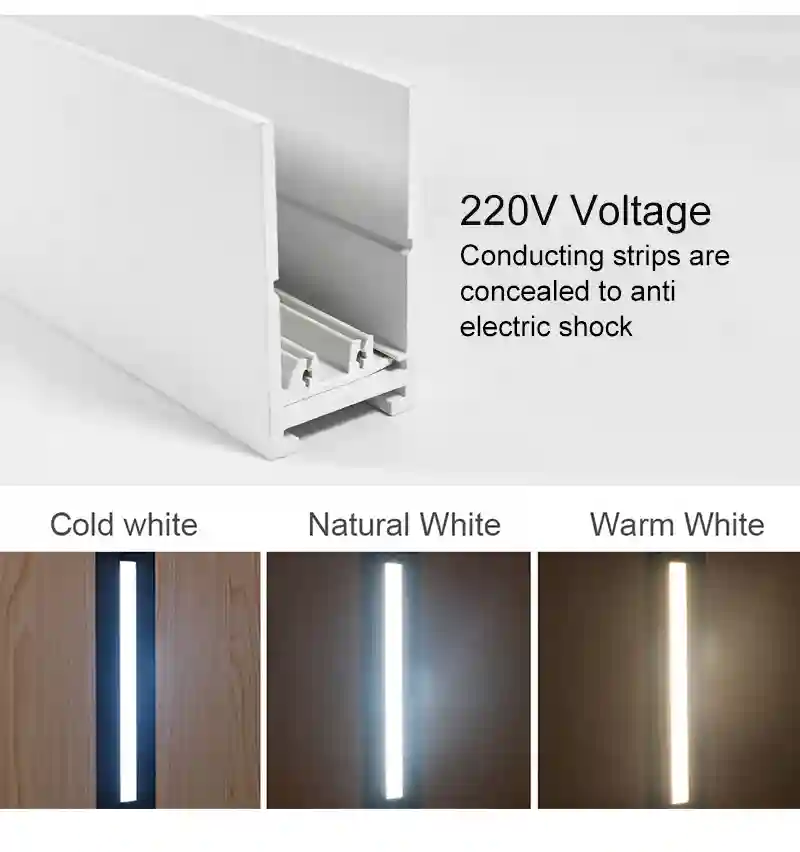
Voltage descriptions belong to specific components. Record the building supply, rail or system supply, lamp voltage, and driver or controller requirement separately. A product marketed as “220V” may state a wider input range.
Verify the Input Range
Sampo’s high-voltage magnetic range lists 90–265V input. The M25 series is positioned for residential lighting, while M35 is positioned for commercial lighting. Review the applicable 220V magnetic track light systems and place the selected series and model numbers on the RFQ.
A separate rail FAQ lists AC110–220V and states that DC depends on the lamp. Ask the supplier to identify the voltage at every interface.
Keep 220V and 48V Systems Separate
Sampo also supplies 48V magnetic track lighting systems. A 48V product belongs to its documented rail, modules, power supply, and controls. Compare complete systems through approved part numbers and drawings.
Approve cross-series substitutions only with written compatibility for the rail, fixture, feed, driver, controller, and connector.
Which Components Belong in the System BOM?
A bill of materials, or BOM, lists every component required for the layout, with its part number, quantity, finish, and compatible system.
| Component Group | Items to Confirm | Common RFQ Control |
|---|---|---|
| Rail | Type, length, circuit format, finish | Layout-based quantities |
| Power and connection | Feed, connector, joint, end cap | Inclusion shown on quote |
| Lighting modules | Spotlight, floodlight, grille, other fixtures | Compatible model list |
| Controls | Driver, dimmer, controller, protocol | Approved combination |
| Installation | Recessed parts, suspension pieces, screws | Method-specific BOM |
| Finishing and spares | PVC cover, spare modules, spare drivers | Separate quantities |
Rail Type, Length, and Circuit Format
Sampo’s FAQ material lists several rail-length examples. One section includes 1m, 1.5m, 2m, and 3m; another magnetic-rail section also includes 2.5m. Treat these as system-dependent options. The same material refers to two-wire, three-wire, and three-phase four-wire formats.
Send the rail path, corners, feeds, and mounting method for a layout-based rail schedule.
Fixture Modules and Compatibility
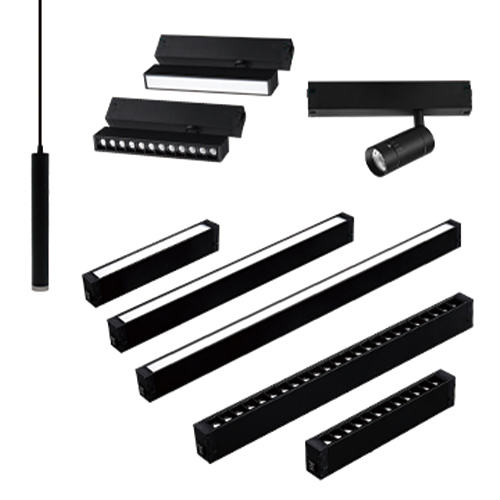
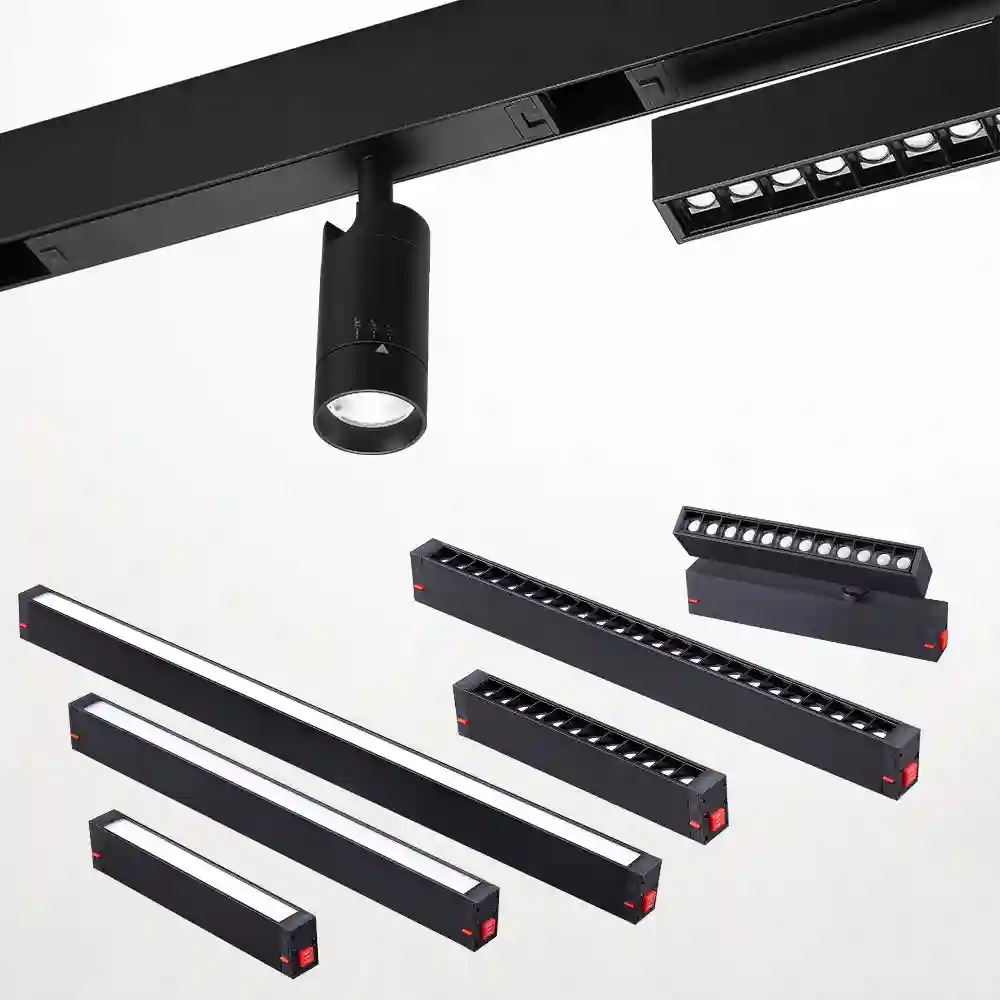
Magnetic systems can include movable spotlights, floodlights, grille lights, and other modules. The quotation should show each compatible fixture model, quantity, wattage, lumens, beam angle, correlated color temperature (CCT), and color rendering index (CRI) where available.
Use the supplier’s LED lighting product range to build an initial module list, then approve the model specifications and compatibility schedule.
Feeds, Connectors, Covers, and Mounting Parts
Power-head and end-cap inclusion depends on the quoted configuration. Sampo also mentions recessed parts, suspension accessories, screw bags, and PVC covers. Put each required accessory on the BOM.
Compare suppliers after this list is complete. This keeps the price comparison tied to the same system scope.
Which Installation Details Must Be Confirmed?
Recessed, Surface-Mounted, or Suspended
The installation method determines the rail, mounting accessories, feeds, connectors, ceiling preparation, and access. Mark it for every rail run.
Recessed layouts need matching recessed parts. Suspended layouts need hanging accessories. Surface-mounted layouts require confirmed fixing points and power-feed positions.
Submit a Dimensioned Layout
The layout should show rail paths, lengths, corners, feeds, fixture positions, ceiling construction, access points, and the application of each fixture group. This information drives the module mix.
Request Installation and Electrical Drawings
Ask for the rail drawing, connections, power-feed arrangement, fixture dimensions, and driver or controller wiring. Approve the documents before production or ceiling work. Record revisions on the purchase order for custom configurations.
Which Fixture and Control Specifications Belong on the RFQ?
Output, Beam, CCT, CRI, and Glare
Request model-specific watts, lumens, beam angle, CCT, CRI, dimensions, and available photometric data. Add the target area and mounting height when the project has a defined lighting requirement.
Put approved model data on the fixture schedule.
Driver, Dimming, and Smart Control
List the fixture, driver, controller, and control method as one combination. Sampo’s high-voltage profile mentions intelligent control; confirm the exact protocol, wiring, accessories, and commissioning instructions by model.
At sample stage, test physical fit, electrical operation, control response, finish, and documents together.
Destination-Market Certification
Certification must match the product and destination. Request the certificate number, covered model, issuing body, validity, and market. Sampo’s FAQ mentions CE for finished products and possible CE, UL, or SAA documents for selected components. Confirm the quoted SKU’s scope.
How Should You Evaluate the Supplier and Commercial Terms?
Samples and Compatibility Testing
Use a sample to verify the rail, fixture, feed, driver, controller, finish, and document revision. Record the approved sample as the purchase-order reference.
MOQ, Packaging, Production, and Shipping
MOQ, sample timing, packaging thresholds, and production estimates vary. Request written terms for the SKU, quantity, customization, packaging, and destination. Add the Incoterm, shipping method, payment schedule, and delivery date.
Warranty and After-Sales Scope
Ask for the warranty period, covered components, claim evidence, remedy, and shipping responsibility. Confirm these terms by product line and purchase contract.
A Copy-Ready Magnetic Track Light RFQ Checklist
-
Destination country and application
-
Mains input and required system voltage
-
Ceiling plan with rail paths, lengths, corners, and feeds
-
Recessed, surface-mounted, or suspended installation
-
Required fixture types and quantities
-
Watts, lumens, beam angle, CCT, CRI, and finish
-
Driver, dimming, controller, and communication protocol
-
Itemized rail, feed, connector, end-cap, mounting, cover, and spare BOM
-
Model specifications, installation drawings, wiring diagrams, and certificate scope
-
Sample requirement and approval criteria
-
Order quantity, logo, packaging, and customization
-
MOQ, production schedule, Incoterm, freight, payment, warranty, and delivery date
Conclusion: Send a Complete System RFQ
A complete Magnetic Track Light inquiry defines the electrical interfaces, layout, modules, controls, documents, and commercial scope. It gives the supplier a basis for compatibility and pricing.
Foshan Sampo Lighting & Electric Co., Ltd. supplies track lights, tracks, downlights, parts, and accessories. Its high-voltage range includes residential M25 and commercial M35 series with a documented 90–265V input. OEM and ODM discussions can cover products, drivers, LED components, logos, packaging, and design requirements.
When the layout and purchase conditions are ready, request a magnetic track light quotation. Send the destination, application, voltage fields, plan, fixture list, controls, certification needs, quantity, finish, packaging, and delivery target. Request a model shortlist, compatibility statement, itemized BOM, drawings, documents, and commercial quotation.
FAQ
Q1: Is a 220V Magnetic Track Light connected directly to mains power?
A: Confirm this by series and model. Sampo’s high-voltage range lists 90–265V input, while FAQ material lists AC110–220V for certain rails and states that DC depends on the lamp. Record mains input, rail voltage, lamp voltage, and driver requirement separately.
Q2: What components should be included in a magnetic track light quotation?
A: Include rails, feeds, connectors, end caps, modules, drivers, controllers, mounting parts, covers, and requested spares. Each item needs a part number, quantity, finish, and compatibility reference. Confirm power-head and end-cap inclusion explicitly.
Q3: Can 220V and 48V magnetic track fixtures use the same rail?
A: Treat them as separate systems unless the supplier provides written model-level compatibility. Confirm the rail, fixture, feed, power supply, driver, controller, and connectors as one approved combination.
Q4: Which documents should a buyer request before ordering?
A: Request model specifications, a compatibility list, itemized BOM, rail layout, installation drawing, wiring diagram, and certification documents. Verify the certificate’s covered model, issuing body, validity, and destination-market scope.
Q5: What information should you send to get an accurate Magnetic Track Light quote?
A: Send the destination country, application, voltage, dimensioned layout, installation method, module list, control method, required specifications, certification needs, quantity, finish, packaging, and delivery date. These inputs allow the supplier to return a model shortlist, BOM, drawings, document list, and commercial terms tied to the project.


