

How to Choose Beam Angle, CCT and CRI for Track Lighting Projects
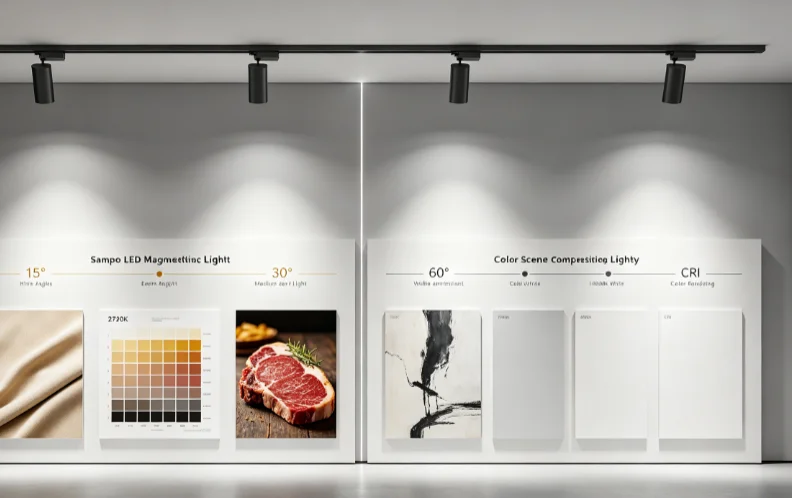
At first glance, track lighting appears to be an uncomplicated product. Pick a rail, add some heads, turn it on. In reality, it can be a lot more complex. A beam angle that is too wide will create spots on the floor, while a wrong CCT can quickly make a café feel cold. And, not to forget, CRI. If this is too low, clothes, food, artwork and also wood finishes look much less pleasant than they actually are. In choosing track lighting, beam angle, CCT and CRI must be chosen together, not one after the other.
Why Beam Angle, CCT and CRI Matter?
Three little details in LED track lighting determine how a space will look and function. Beyond light, you are choosing how to focus attention, how to make people feel, what color to be, and how first impressions will be made.
Beam Angle Controls Where People Look
Beam angle is the width of the light coming from a track light. A narrow beam angle creates a clear spotlight effect. It works well for jewelry, mannequins, paintings, reception logos, or a feature table in a restaurant. A medium beam angle gives safer coverage for shelves and wall displays. A wide beam angle supports ambient lighting and walkways.
For most commercial track lighting applications, 24° to 36° is a good starting point. But don’t use that angle everywhere. A retail store might use 15° to 24° for hero products, 24° to 36° for product on the shelves, and 36° to 60° for products on aisles. That’s more natural.
CCT Sets the Mood
CCT lighting is measured in Kelvin. Warm white lighting, often around 2700K to 3000K, feels relaxed and soft. Neutral white lighting, around 3500K to 4000K, feels cleaner and more practical. Cool white lighting can make details look sharper, but it may feel harsh in hospitality lighting if used without care.
For this example, we’re going to look at a few scenarios and how lighting affects each of them. We’ll use a bakery counter, a fashion store, and an office lobby for these examples. A bakery counter is a great place to start when talking about how warm lighting can make a product look fresh. This type of lighting is also often used in a fashion store to allow for better judgment of colors, and a 4000K level of lighting is usually enough to keep a large office lobby looking tidy without appearing too clinical.
CRI Protects Color Quality
CRI stands for Color Rendering Index lighting, it determines how colors will look very well under your chosen light. For common areas around a home such as hallways, living rooms, etc. an 80 CRI could be sufficient, however, in retail spaces, restaurants, galleries and show rooms with displays of products to sell, a high CRI lighting will pay for itself by showing the most accurate colors possible. Aim for a CRI of 90, which is a practical mark to work with in trying to showcase products at their best.
A low CRI track light may make to look dull red, steak look grey and wooden panel work lose its warmth. We don’t know if our customers know that this is due to a low color rendering index but they can certainly feel a difference.
How Should You Choose Beam Angle by Space?
Each space has it’s own pain points. A store owner will want products to stand out, a restaurant manager won’t want glare on tables, a gallery designer will not want reflections off of glass frames. So selecting a beam angle for a space should start with how that space looks.
Retail Lighting
Narrow beam angle lighting should be used to highlight window displays, new arrivals and high value products. Medium beam angle lighting should be used to illuminate rows of racks and shelves. Wide beam angle lighting should be used in areas where people will be comfortably standing and moving about such as the aisles.
In low ceiling installations narrow beam distribution can be too aggressive. This can be addressed with additional glare control, deeper optics, or increased beam width.
Restaurant and Hotel Lighting
When it comes to Restaurant Track Lighting we want to concentrate on providing Warm White Lighting and Good Visual Comfort over simple brightness. With this in mind 15° to 30° beams are good for highlighting individual tables or specific features of the bar such as a wall. For general accent lighting wider beams of 24° to 36° work best. This allows you to use very wide beams for lining paths, waiting areas etc or provide soft general background lighting.
An unwanted bright circle on your food and dark areas on your plate are things nobody wants to see. An aiming test before installing the lighting can prevent a lot of problems.
Gallery and Showroom Lighting
For Gallery applications track lighting requires greater control. A 10° to 20° beam angle is typically recommended for smaller works of art, larger works can be lit with a beam spread of 24° to 30°. Spec high CRI track, angle precisely and provide strong glare control, especially in rooms with lots of glass, very glossy floors or contain large amounts of metal.
Which Sampo Lighting Products Fit Track Lighting Projects?
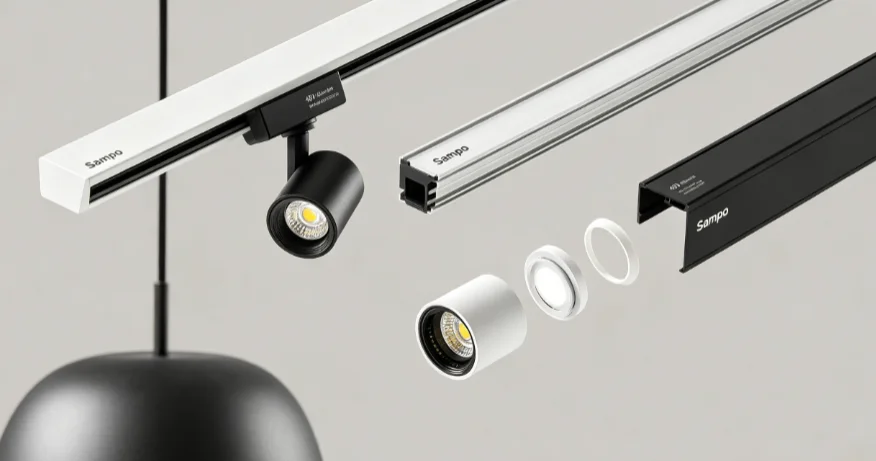
Sampo Lighting is one of practical Chinese manufacturers who can provide you with the best design freedom and stable products for your projects. Sampo Lighting is a professional LED lighting manufacturer which is founded in 2014 and is based in Foshan city. The main products of Sampo include LED track lights, LED lighting tracks, LED downlights as well as the relevant components and so on. Moreover, the company also provides the services of OEM/ODM, sales and after-sales service.
With its relatively large factory scale, experienced engineering team and comprehensive product line, Sampo can be a very good choice for most of commercial and residential lighting system projects. Clients can choose different types of rails and various types of fixtures, adjust different beam angles, choose different CCT values and different CRI values to meet the demands of their projects.
Magnetic Track Light Systems
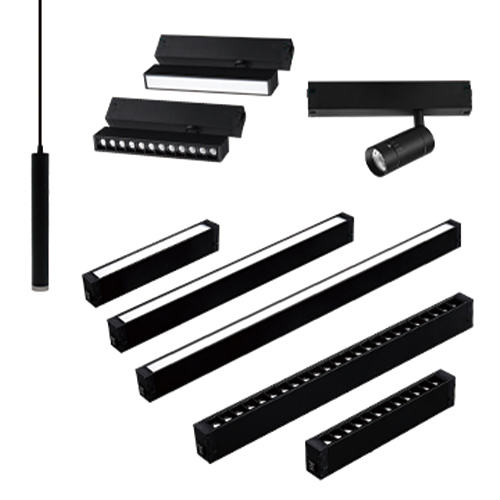
Flexible LED track lighting setups can be achieved with the right choice of LED track lighting products. 220V Magnetic Track Light System, 48V Magnetic Track Light System, Semi-flexible Magnetic Track Light System, Ultra-narrow Magnetic Track Light System, Ultra-thin Magnetic Track Light System and T10 Square Tube Light are ideal for setting up flexible track lighting system.
48V Magnetic Track Light System: This system includes low-voltage magnetic rails, linear grille lights, COB spotlights, pendant lights, floodlights and more. Also available is the Ultra-narrow Magnetic Track Light System for very slim interiors, galleries and shops with very clean ceilings. Here you can find mini spotlights, very narrow grille fill lights and lights with variable beam angle.
What Common Mistakes Should You Avoid?
Most mistakes in good lighting design are minor errors that can develop into huge site related problems long after the fixtures have been specified.
Using One Beam Angle Everywhere
A single beam angle for the whole shop equals flat and boring lighting. To avoid this, mix the beams.
Ignoring Mounting Height
A 15° beam coming from a high ceiling might appear to be a sharp, effective beam, but coming from a low ceiling it could create strong glare and hotspots. It is always best to check the mounting height and target size.
Choosing CCT Without the Interior Finish
Warm wood, black marble, white walls and polished metal all have different responses to color temperature. Test samples if possible, as this is a relatively simple thing to check and one would hate to find out something unpleasant at a late stage in the project.
Treating CRI as Optional
For commercial space the aspect of color rendering is an important part of the customer experience. When people buy clothes, food, cosmetics, art or even premium furniture, a high CRI lighting is no longer a luxury detail. It has become a part of the sale.
FAQ
Q1: What Is the Best Beam Angle for Track Lighting?
A: There is no single best beam angle for track lighting. Use narrow angle for focus, medium angle for typical shelf or accent wall applications, and wide angle for comfort or for general lighting.
Q2: 3000K or 4000K Better for Commercial Lighting?
A: Both temperatures have their applications. 3000K creates a warm ambient glow that is ideally suited for Restaurants, Hotels and other Cozy Retailer Applications whilst 4000K creates a cleaner, more energized appearance typically found in Office Spaces, Showrooms and indeed selected Fashion Retailer Applications.
Q3: Is CRI 90 Lighting Necessary?
A: CRI 90 Lighting is recommended for retail, restaurants, galleries, showrooms and any other application where color accuracy is crucial to customer’s purchasing decisions.
Q4: How Does Beam Angle Affect Glare Control?
A: A narrow beam can create very strong glare if it is not directed properly or if the optic is not deep enough. Use proper aiming, use proper shielding and a balanced ambient layer.
Q5: Can One Track Lighting System Fit Different Areas?
A: Yes, if the system supports different fixture types, beam spreads, CCT options, and mounting methods. Magnetic track systems are often useful for this kind of flexible layout.


